
Overview
Composite Veneers
& Bonding.
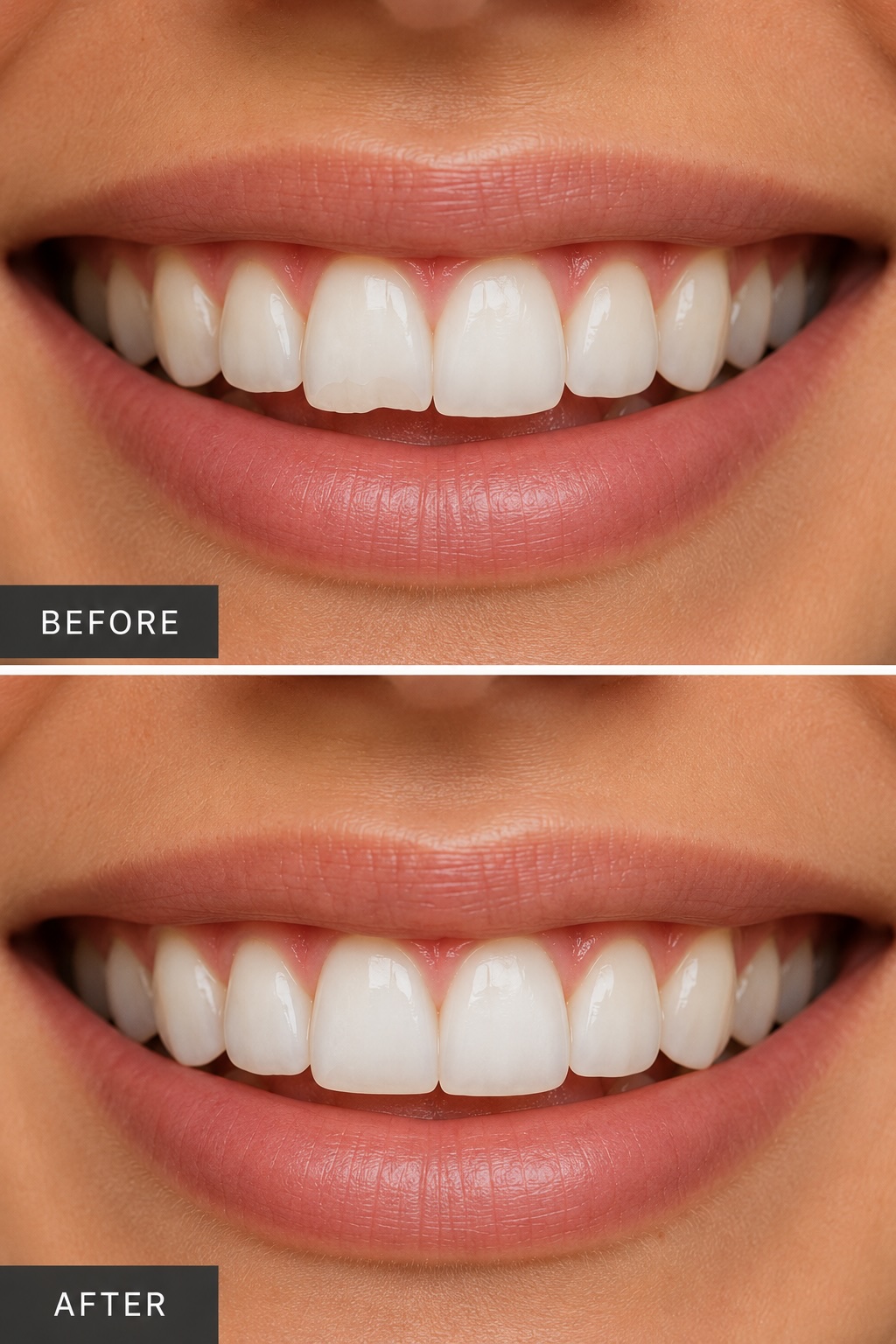
Composite veneers & bonding is a direct application of tooth-coloured composite resin material that is used to enhance, yet blend harmoniously with the teeth to produce a natural result.
Bonding can involve a minimal touch up of a small chip, or it can be used to add length to several teeth; whereas veneering involves the full front facing over the existing tooth surface. This may be an ideal option if there is considerable change needed to the colour, shape, and/or position of the teeth.
Whether veneering or bonding, there is typically some degree of tooth preparation and the degree of preparation is dependent on the desired result. No prep or minimal prep veneers are commonly advertised and attractive from a marketing standpoint, however in practical application the consequences of no prep or insufficient prep often result in over-contoured teeth that feel and appear unnatural. Adequate preparation allows the composite material to sit within the natural tooth profile, achieving a seamless, aesthetic outcome that looks and feels like your own teeth.
Durability
Strong &
Durable.
Composite resin offers a solid solution when restoring teeth and has excellent strength and wear properties. The material needs to be a certain thickness or it will fracture — on the other hand if it is too thick it looks and feels unnatural. Our goal is to ensure we are ticking all the boxes for longevity along with a natural look and feel.
It is important to be aware that composite has a limited lifespan and dependent on the area restored can last for five years up to fifteen years. For those looking for longer lasting results, we typically recommend porcelain as the material of choice.
Bonding or veneering is not suitable for those with severe wear from erosion or bruxism or those with a heavily restored dentition. This is where crowns offer a more durable option.
Treatment considerations and risks can be found here.
Investment
Investment
Considerations.
There is a large range in pricing depending on the exact procedure being done and how many teeth are being restored. Please refer to our price guide.
We offer multiple payment options and payment plans.
Veneering is considered elective cosmetic treatment and often is not covered by health funds.

Smile Studio
Real Patients.
Real Results.
Browse actual patient cases treated at Element Dental — composite bonding, veneers, and full smile transformations.
View the Smile Studio →Common Questions
Composite Veneers
& Bonding FAQs.
Composite bonding is a direct restorative technique where a tooth-coloured resin material is carefully shaped and sculpted onto the tooth surface in a single appointment. It's one of the most versatile tools in cosmetic dentistry — able to address chipped or worn teeth, small gaps, uneven edges, discolouration, misshapen teeth, and even black triangles between teeth. Because it's applied directly to the tooth without the need for a laboratory, it's faster, more affordable, and more conservative than ceramic veneers — though it does come with different trade-offs.
The two treatments address many of the same concerns but in fundamentally different ways. Composite bonding is a direct restoration — the material is placed and sculpted chair-side in a single visit, with minimal or no preparation of the underlying tooth. Ceramic veneers are indirect restorations, custom-made by a master ceramist outside the mouth and bonded at a second appointment. Ceramics offer superior aesthetics, greater stain resistance and significantly longer longevity — but at a higher cost and with more tooth involvement. Composite is a brilliant option for the right case, and in skilled hands produces results that are genuinely beautiful. The best choice depends on your specific teeth, goals and budget.
With good care, composite bonding typically lasts around seven years. Longevity depends on a number of factors — how well you maintain your oral hygiene, your diet, whether you grind or clench, and the location and extent of the bonding. We always recommend wearing a night splint to protect composite work, and attending regular check-ups so we can monitor and maintain it over time.
Yes — and this is one of its significant advantages. Because composite is a direct material, small chips or wear can almost always be repaired chair-side in a single appointment, without replacing the entire restoration. Ceramic veneers, by comparison, typically cannot be repaired and must be remade if they fracture significantly.
In most cases, yes. Where bonding is placed on an unprepared tooth surface, it can be removed without affecting the underlying enamel. This makes it one of the most conservative cosmetic options available — you're adding to the tooth rather than removing from it. We'll always discuss what's involved in your specific case before beginning treatment.
For most patients, composite bonding is completed in a single appointment. The length of that appointment depends on the number of teeth being treated — a single tooth may take an hour, while a full smile makeover involving multiple teeth may take considerably longer. We'll give you a clear time estimate when we plan your treatment.
Ready to explore
your options?
General & Cosmetic Dentistry & Implant Centre
– Erina Dentist