Overview
Porcelain
Creations.
Porcelain veneers are thin coverings that are cemented to the surface of prepared teeth to enhance the appearance of teeth. The glass-like properties provide not only a natural look, but also a natural feel.
Veneers are typically considered when a healthy aesthetic smile cannot be achieved through more conservative treatment options such as whitening, bonding, and/or orthodontics.
They can address concerns such as discolouration, misshapen teeth, poor positioning, worn or chipped teeth, small teeth, and gaps between teeth — however there are limitations. Due to the very specific indication of veneers and their limitations, it is important to discuss this treatment with an experienced cosmetic dentist.
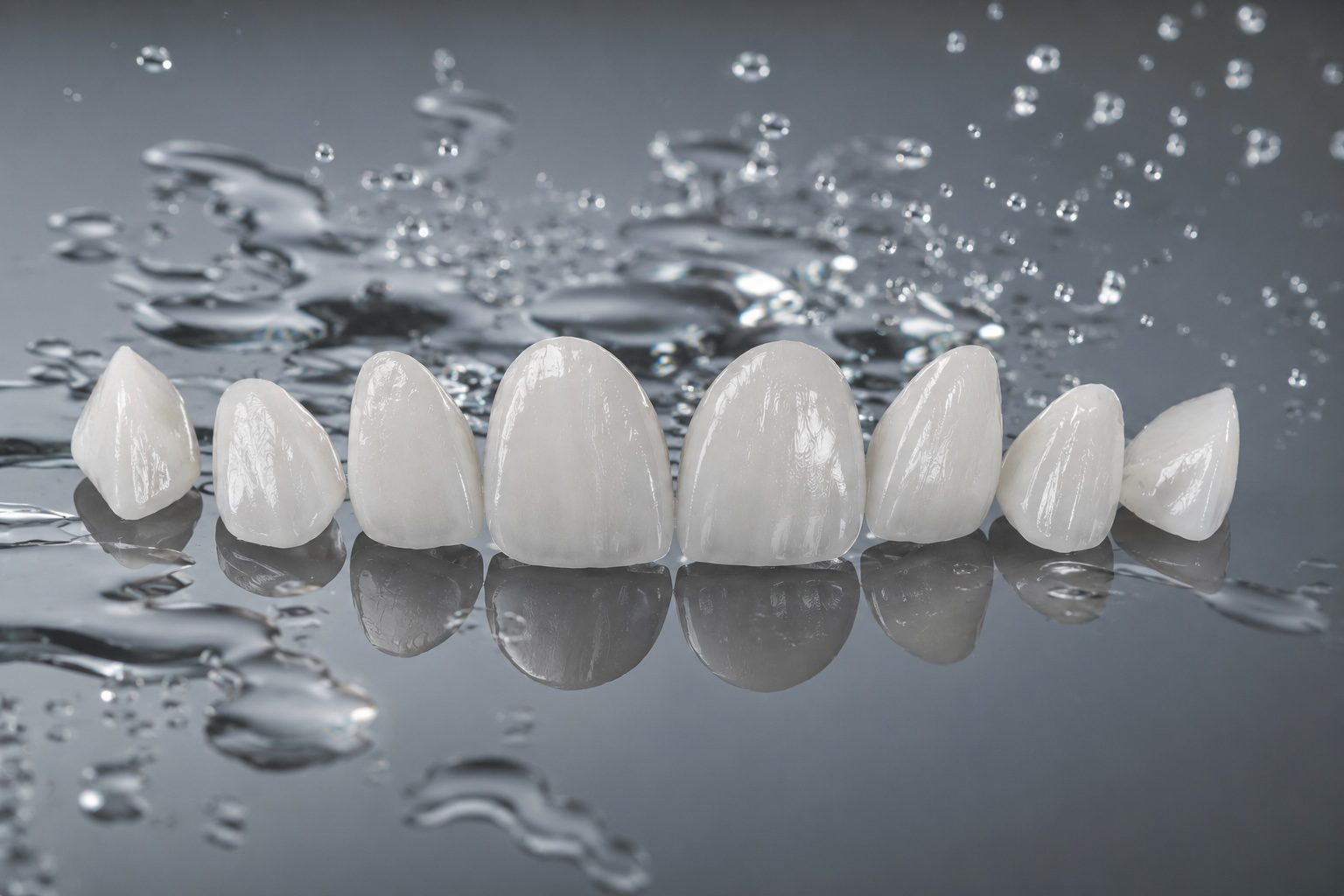
For illustration purposes only. Individual treatment planning and outcomes may vary.
Our Approach
The Element
Difference.
At Element Dental, our experienced dentists listen to your goals and provide skilled guidance to design a treatment plan tailored specifically to you.
Fully Informed
We ensure you are fully informed every step of the way. Your new veneers are carefully planned using dental photography and smile design software.
Preview Your Smile
In most cases, patients preview their new smile through a diagnostic wax-up and intra-oral try-in before treatment begins.
Master Ceramists
We work closely with select master ceramists who recreate nature through artistically shaping and blending porcelain hues, translucencies, and textures. Every veneer is hand-crafted — not milled in a machine — for a result that is genuinely indistinguishable from your own teeth.
Investment
Investment
Considerations.
Porcelain veneers are a considered investment in your smile. Pricing varies depending on the number of teeth and complexity of treatment. Please refer to our price guide for full details.
We offer multiple payment options and payment plans to make treatment accessible.

Smile Studio
Real Patients.
Real Results.
Browse actual patient cases treated at Element Dental — porcelain veneers, composite bonding, and full smile transformations.
View the Smile Studio →Common Questions
Porcelain Veneer
FAQs.
Porcelain veneers are ultra-thin ceramic shells bonded to the front surface of teeth to refine their shape, size and colour. They're one of dentistry's most requested treatments — and one of its most misunderstood. The honest truth is that veneers come with real limitations that are rarely discussed. Their minimal thickness affects how much colour correction is achievable, particularly on very dark teeth. Their strength, while impressive, has boundaries. And critically — a veneer can only work within the dimensions of the tooth beneath it. A narrow tooth stays a narrow tooth. A severely rotated tooth or one that's heavily restored may not be a candidate at all. When underlying issues — spacing, rotation, proportion — haven't been addressed first, the end result will always be compromised, no matter how beautiful the ceramic work. A significant part of our practice is corrective veneer work: redoing cases where these fundamentals were skipped. Done well and on the right teeth, veneers are transformative.
To achieve a veneer that looks truly natural — one with the right profile, the right colour, and an emergence from the gum that doesn't look stuck on — a minimal preparation of the underlying tooth is almost always necessary. We're typically talking around a millimetre. The alternative is a "no prep" veneer: material cemented directly onto an unprepared tooth. It sounds appealing, but even 1.0 mm of added thickness creates visible bulk at the gumline and an unnatural profile that's hard to disguise. Our philosophy is to remove only exactly what's needed to achieve an optimal result — nothing more. The goal is a restoration that looks, feels and functions like your own tooth.
With proper home care and routine dental visits, ceramic veneers typically last 15 to 20 years. We also strongly recommend wearing an occlusal splint at night — grinding and clenching are the primary causes of premature veneer failure, and a splint is the most effective protection available.
The terminology is genuinely confusing — even within dentistry. "Porcelain veneer" is the term most people know, but it's something of a misnomer. True porcelain is an almost entirely glass-based material: extraordinarily beautiful in its optical properties, but brittle. It still has a role in select aesthetic cases, but it has largely been superseded. The modern "porcelain veneer" is more accurately a ceramic veneer — most commonly made from lithium disilicate, a glass-ceramic material where crystalline structures dispersed throughout the glass matrix dramatically increase strength without sacrificing the lifelike translucency that makes a great veneer indistinguishable from a natural tooth. These are indirect restorations — made outside the mouth, ideally by a master ceramist who hand-layers the material to replicate the natural depth and variation of real enamel. Composite veneers are an entirely different proposition: a resin material shaped directly onto the tooth in a single appointment, with no lab involved. They're a wonderful option in the right circumstances, but they stain over time and will need periodic replacement or touch-up.
Any tooth that has been prepared for a veneer is fitted with a temporary covering made from a tooth-coloured acrylic material. These are worn for approximately two weeks while your ceramic veneers are being crafted by our ceramist. Temporaries are functional and presentable — not the final result by any measure, but more than passable for everyday life during that short window. They also give you a first glimpse of the proposed shape and length, and an opportunity to flag anything you'd like refined before the final ceramics are seated.
Not at all. The preparation appointment involves a local anaesthetic, which is the most uncomfortable part of the whole process. Some patients notice mild sensitivity to hot and cold during the temporisation phase — the period between preparation and fitting your final veneers — but this resolves once the ceramics are bonded in place.
Ceramic veneers are highly stain-resistant — it's one of their most significant advantages over natural enamel, which yellows with age and lifestyle. Your ceramic veneers will look the same in fifteen years as they do on day one. Composite veneers, on the other hand, are more porous and will absorb pigment from coffee, red wine and other staining foods over time — this is one of the key trade-offs to weigh when choosing between the two options.
Our ceramic (porcelain) veneers range from $1,600 to $2,000 per tooth, depending on the number being placed. Composite veneers are $550 per tooth. A full breakdown of our fees is available in our Price Guide.